
Cooking better
How to halve a recipe for fewer servings
A practical way to cook fewer portions: do the ingredient maths, then check what changes in the pan.
 By Salsa
THE SHORT ANSWER
To make half a recipe, divide each measured ingredient by two and keep the original method as your starting point. Use a pan suited to the smaller amount, start checking for doneness early and season to taste. Do not automatically halve the oven temperature or cooking time.
Cooking for one or two is easier when you plan the smaller batch before the heat goes on. Ingredient arithmetic is the simple part. The amount in a pan, how quickly liquid evaporates and how you judge when food is ready need a separate check.
Start with the servings, not a guess
Read the recipe’s stated yield first. If it serves four and you want two, the multiplier is 2 ÷ 4 = ½. Multiply every measured ingredient by one half. For a different yield, divide the servings you want by the original servings: a six-serving recipe for two has a one-third multiplier.
Write down the new amounts beside the whole ingredient list before cooking. Look for an ingredient marked “divided” and scale its total amount only once; then distribute that new total across the same method steps. If the source does not give a clear yield or complete quantities, check the original rather than treating the numbers as certain.
Halve the ingredients carefully
Weight is convenient when a recipe gives grams: 300 g of pasta becomes 150 g. For cups and spoons, convert to a smaller measure when that is easier to use. These examples are arithmetic, not a new tested recipe.
| Original amount | Half amount | Useful measure |
|---|---|---|
| 1 cup | ½ cup | Use a half-cup measure. |
| ¾ cup | ⅜ cup | ¼ cup plus 2 tablespoons. |
| ⅓ cup | ⅙ cup | 2 tablespoons plus 2 teaspoons. |
| 1 tablespoon | ½ tablespoon | 1½ teaspoons. |
| 1 egg | ½ beaten egg | Beat it first, then measure half. |
For a single egg in a baked recipe, beat it well and measure half of the beaten egg. King Arthur Baking recommends weighing the beaten egg when precision matters. For a savoury dish, taste-sensitive ingredients such as salt, chilli and strong spices can start below the calculated half amount; add more after tasting. This is also the advice in K-State Research and Extension’s reducing-a-recipe guide.
Match the pan to the smaller batch
For a sauce or sauté, choose a saucepan or skillet that lets the food sit at a useful depth without crowding. A half batch in the original wide pan can lose liquid faster. If you keep the larger pan, watch the food and add liquid only if the original method calls for it or the sauce clearly needs it.
Baking needs extra care. A smaller amount of batter in the same tin will be shallower. For many cakes and bars, a pan with roughly half the original base area keeps the depth closer to the original. An original 9 × 13 inch pan has 117 square inches of area; half is 58.5. An 8 inch square pan is 64 square inches, which is reasonably close, though the fit depends on the recipe and pan depth. King Arthur’s pan guide explains the area method. If a baking recipe is very precise or needs awkward partial amounts, making the full batch and freezing suitable leftovers may be simpler.
Check timing and doneness separately
Keep the recipe’s oven temperature unless the source gives a reason to change it for a different pan material. Less food may cook faster, but there is no reliable “half recipe = half time” rule. Use the original time as a reference, begin checking early and follow the recipe’s visual or texture cues. K-State’s guide also advises using a food thermometer for foods with a safe end-point temperature.
For a reduced sauce, watch the consistency as it simmers. For baked food, check the centre as the source describes. A timer helps you remember to look; it does not tell you that the food is done. Keep any food-safety temperatures and handling instructions from the original recipe.
Adjust servings while you cook in Salsa
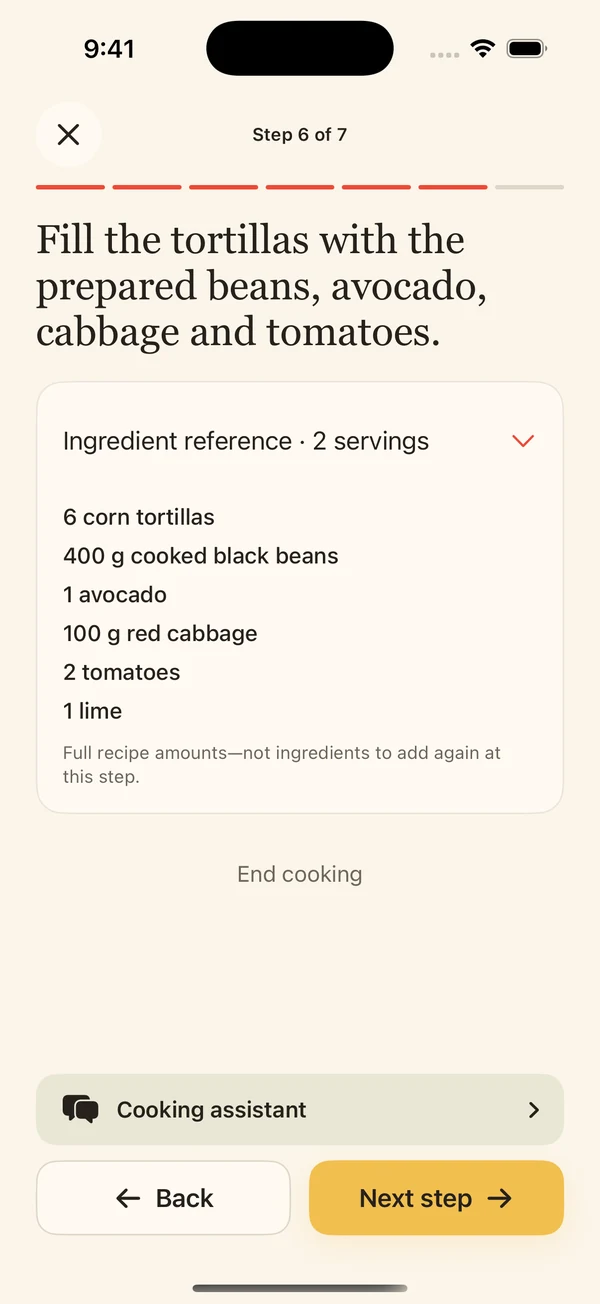
Salsa’s released iPhone app includes serving adjustments for saved recipes, with ingredient amounts shown during guided cooking. Set the yield you want before starting, then check unusual amounts, seasonings, pan choice and cooking time against the original recipe. An adjusted ingredient list cannot decide those cooking details for you.
If the recipe is still online, save the full recipe first, including its original serving count and method. See Salsa’s current App Store listing for availability and features.
Common questions
Does half a recipe take half the time?
No fixed proportion works across recipes. The smaller amount, pan shape and food depth can change the timing. Check earlier and use the original doneness cues.
How do I halve one egg?
Beat the whole egg until combined, then use half of the beaten amount. A scale is useful for precise baking; do not guess at “half a yolk.”
Should I halve salt and spices exactly?
Use the maths as a starting point, but for strongly flavoured seasonings it is sensible to start with less and taste. For baking ingredients that affect structure, follow precise scaled amounts or choose a tested smaller recipe.
Can I use the same baking pan?
Possibly, but a shallow layer can bake differently. Compare the batter depth and pan area with the original recipe, and begin checking early.